


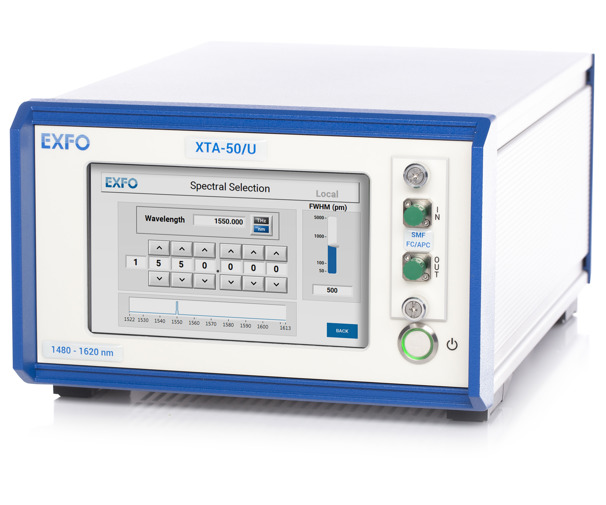
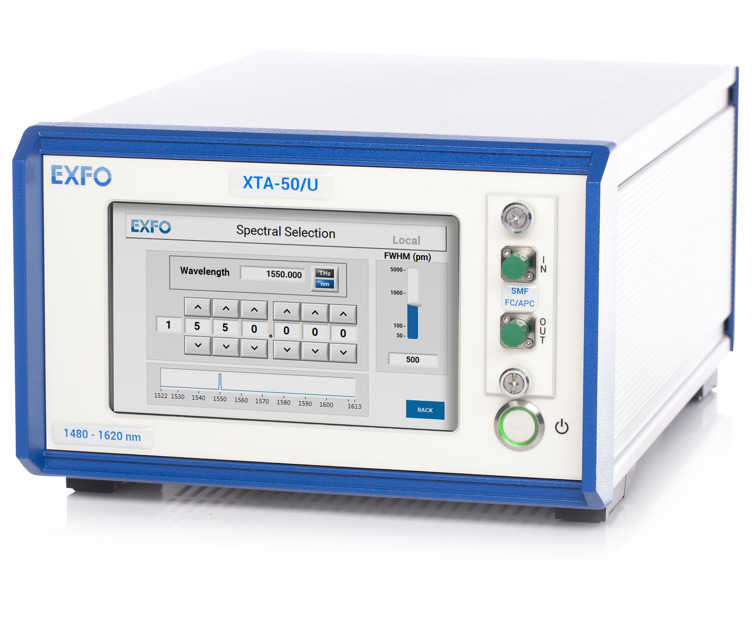
| Models | XTA-50 standard; XTA-50 ultrafine; XTA-50 O-band a; XTA-50 wide |
| Wavelength range (nm) | Standard: 1450 to 1650; Ultrafine: 1480 to 1620; O-band: 1260 to 1360; Wide: 1525 to 1610 |
| Wavelength resolution (pm) | Standard: 1; Ultrafine: 1; O-band: 1; Wide: 1 |
| Wavelength accuracy (pm) b | Standard: ±30; Ultrafine: ±30; O-band: ±30; Wide: ±30 |
| Wavelength tuning speed (s) | Standard: 1; Ultrafine: 1; O-band: 1; Wide: 1 |
| Minimum bandwidth (FWHM) | Standard: 50 pm (6.25 GHz); Ultrafine: 32 pm (4 GHz); O-band: 50 pm (8 GHz); Wide: 50 pm (6.25 GHz) |
| Maximum bandwidth (FWHM) | Standard: 950 pm (120 GHz); Ultrafine: 650 pm (80 GHz); O-band: 900 pm (160 GHz); Wide: 5000 pm (625 GHz) |
| Bandwidth resolution (pm) | Standard: 1; Ultrafine: 1; O-band: 1; Wide: 1 |
| Bandwidth tuning speed (s) | Standard: 1; Ultrafine: 1; O-band: 1; Wide: 1 |
| Filter edge roll-off (dB/nm) | Standard: 500 (typical) c; Ultrafine: 800 (typical); O-band: 500 (typical) c; Wide: 500 (typical) d |
| Insertion loss (dB) | Standard: 5 (4.5 dB typical) e, f; Ultrafine: 5 (4.0 dB typical) f, g; O-band: 5 (4.5 dB typical) f, h; Wide: 5 (4.5 dB typical) i, j |
| Flatness (dB) | Standard: 0.2 k; Ultrafine: 0.2 l; O-band: 0.3 k, m; Wide: 0.2 n |
| Polarization dependent loss (dB) | Standard: ±0.2 e; Ultrafine: ±0.2 g; O-band: ±0.2 h; Wide: ±0.2 i |
| Out-of-band suppression (crosstalk) | Standard: 40 dB (60 dB typical) o; Ultrafine: 40 dB (50 dB typical) o; O-band: 40 dB (60 dB typical) o; Wide: 40 dB (45 dB typical) o |
| Display | 7 inch resistive touch-screen (resolution 800 x 480) |
| Communication interfaces | USB-B, Ethernet (x2) |
| Display and other interfaces | HDMI, display port, USB-A 3.2 (x3), USB-A 2.0 (x1) |
| Optical fiber type | Standard: SMF or PMF; Ultrafine: SMF or PMF; O-band: SMF or PMF; Wide: SMF |
| Connector type | FC/PC or FC/APC |
| a. Specifications apply for wavelengths not equal to anywater absorption line. b. With “Backlash suppression” setting enabled. c. Between –3 and –40 dB for FWHM < 800 pm. d. Between –3 and –40 dB. Typically 550 dB/nm at FWHM = 50 pm, 450 dB/nm at FWHM = 1 nm, 225 dB/nm at FWHM = 5 nm. e. From 1500 nm to 1600 nm and FWHM > 100 pm. f. At lowest FWHM the insertion loss is 7 dB typical. g. From 1500 nm to 1600 nm and FWHM > 60 pm. h. From 1280 nm to 1340 nm and FWHM > 100 pm. i. For FWHM > 100 pm. j. At lowest FWHM the insertion loss is < 7.0 dB. k. Centered width of FWHM-150 pm. For 150 pm < FWHM < 650 pm. l. Centered width of FWHM-100 pm. For 100 pm < FWHM < 500 pm. m. From 1280 nm to 1340 nm. n. Centered width of FWHM-150 pm. For 150 pm < FWHM < 2000 pm. o. Measured 1 nm away from the –3 dB points. | |
| Temperature range | 15 °C to 35 °C (59 °F to 95 °F) |
| Maximum optical input power (dBm) | Standard: 30; Ultrafine: 30; O-band: 30; Wide: 27 |
| Dimensions (W x D x H) | 254 mm x 385 mm x 154 mm (10 in x 15 1/8 in x 6 in) |
| Weight | 6.5 kg (14.33 lb) |