


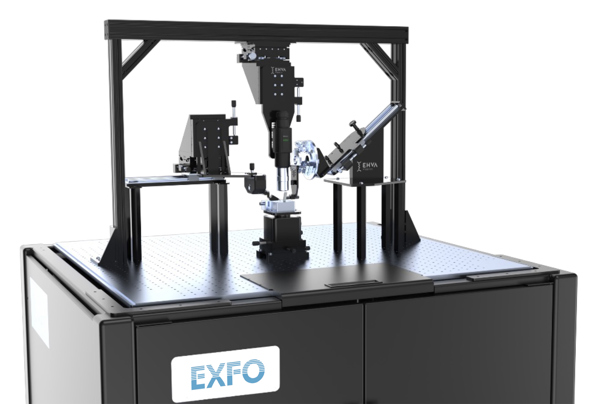
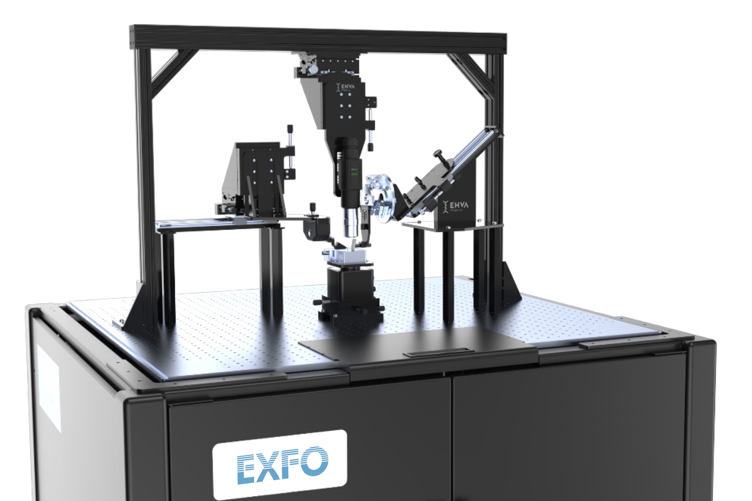
| SINGLE-DIE BASE STAGE, 4-AXIS MANUAL | |
| X, Y axis travel (mm) | 27 |
| Z axis travel (mm) | 9 |
| Rz axis travel (degrees) | 20 |
| X, Y axis displacement/revolution (mm) | 0.3175 |
| Z axis displacement/revolution (mm) | 0.085 |
| Rz axis displacement/revolution (degrees) | 1.2 |
| SPECIFICATIONS | |
| Standard OPAL-SD test station includes | one OPAL-SD chuck stage motion system, one TA chuck, a top and side vision system, PC with PILOT software license and accessories. |
| CHUCK | |
| Option name | TA; TCH |
| Sample area (TA; TCH) | TA: 50 × 50 mm2; TCH: 50 × 50 mm2 |
| Range (TA; TCH) | TA: Room temperature; TCH: 0 °C to 120 °C (32 °F to 248 °F) |
| Resolution (TA; TCH) | TA: 0.01 °C (32 °F); TCH: 0.01 °C (32 °F) |
| Stability (TA; TCH) | TA: 0.05 °C (32 °F); TCH: 0.05 °C (32 °F) |
| Heating rate (TA; TCH) | TA: 40 °C/min (68 °F/min); TCH: 40 °C/min (68 °F/min) |
| Cooling rate (TA; TCH) | TA: –15 °C/min (14 °F/min); TCH: –15 °C/min (14 °F/min) |
| Vacuum zones (TA; TCH) | TA: 1 zone, electronically controlled; TCH: 3 custom vacuum zones, electrically controlled |
| Electrical surface | Electrical surface grounded (triaxial as option) |
| OPTICAL HEAD | |
| Option name | PRO-P60; PRO-P40 |
| Motorized axis (PRO-P60; PRO-P40) | PRO-P60: X, Y, Z, Rx, Ry, Rz; PRO-P40: X, Y, Z, Ry (pitch) |
| Manual axis | Rx (yaw), Rz (roll) |
| Motor type (PRO-P60; PRO-P40) | PRO-P60: Piezo, hexapod; PRO-P40: X, Y, Z: DC servo; Ry: stepper |
| X axis travel (mm) (PRO-P60; PRO-P40) | PRO-P60: 20; PRO-P40: 25 |
| Y axis travel (mm) (PRO-P60; PRO-P40) | PRO-P60: 11; PRO-P40: 25 |
| Z axis travel (mm) (PRO-P60; PRO-P40) | PRO-P60: 20; PRO-P40: 4.8 |
| X axis resolution (nm) (PRO-P60; PRO-P40) | PRO-P60: 1; PRO-P40: 10 |
| Y axis resolution (nm) (PRO-P60; PRO-P40) | PRO-P60: 1; PRO-P40: 10 |
| Z axis resolution (nm) (PRO-P60; PRO-P40) | PRO-P60: 1; PRO-P40: 60 |
| X axis repeatability (nm) | Uni-directional: 50; Bi-directional, typical: ±70 |
| Y axis repeatability (nm) | Uni-directional: 50; Bi-directional, typical: ±70 |
| Z axis repeatability (nm) | Uni-directional: 50; Uni-directional, typical: ±250; Bi-directional, typical: 100 |
| Rx axis travel (PRO-P60; PRO-P40) | PRO-P60: 23°; PRO-P40: 10° |
| Ry axis travel (PRO-P60; PRO-P40) | PRO-P60: 38°; PRO-P40: 10° |
| Rz axis travel (PRO-P60; PRO-P40) | PRO-P60: 26°; PRO-P40: 360° coarse, 10° fine |
| Rx axis resolution | 0.04 arcsec; 0.00001°; 50.8 (TPI) |
| Ry axis resolution | 0.04 arcsec; 0.00001°; 4 arcsec; 0.0002° |
| Rz axis resolution | 0.04 arcsec; 0.00001°; 50.8 (TPI) |
| Rx axis repeatability | Uni-directional: 1.5 arcsec; 0.0004° |
| Ry axis repeatability | Uni-directional: 1.5 arcsec; 0.0004°; Bi-directional, typical: 7 arcsec; 0.0003°; Uni-directional, typical: 0.8 arcsec; 0.0002° |
| Rz axis repeatability | Uni-directional: 1.5 arcsec; 0.0004° |
| Pivot point capability (PRO-P60; PRO-P40) | PRO-P60: Yes; PRO-P40: No |
| Possible orientations (PRO-P60; PRO-P40) | PRO-P60: North/East/West; PRO-P40: North/East/West |
| Included | Rail system for toggling into engaged/disengaged positions, fiber array holder and single fiber holder, fiber array holder and single fiber holder counterweight |
| Optical head options | ECO-30, 40, 60 – 3, 4 OR 6 MOTORIZED AXIS, SCREW-DRIVEN |
| X, Y, Z axis travel (mm) (ECO-30, 40, 60) | 25 (X, Y), 12.5 (Z) |
| X, Y, Z axis resolution (nm) (ECO-30, 40, 60) | 200 (X, Y), 25 (Z) |
| X, Y, Z axis bidirectional repeatability (nm) (ECO-30, 40, 60) | Typical: 125 (X, Y, Z) |
| X, Y, Z axis accuracy (µm) (ECO-30, 40, 60) | Typical: ±4 (X, Y), ±1.5 (Z) |
| ELECTRICAL HEAD | |
| Option name | PRE-00; PRE-MO |
| Translation stages type (PRE-00; PRE-MO) | PRE-00: Manual; PRE-MO: Motorized X, Y, Z, manual probe angle |
| X, Y axis travel range (mm) (PRE-00; PRE-MO) | PRE-00: 48; PRE-MO: 25 |
| Z axis travel range (mm) (PRE-00; PRE-MO) | PRE-00: 48; PRE-MO: 25 |
| X, Y, Z axis resolution (nm) (PRE-00; PRE-MO) | PRE-00: -; PRE-MO: 200 |
| X, Y, Z axis repeatability (μm) (PRE-00; PRE-MO) | PRE-00: -; PRE-MO: 1, Bi-directional, typical: 0.3 |
| X, Y, Z axis accuracy (μm) (PRE-00; PRE-MO) | PRE-00: Typical: 2; PRE-MO: 5 |
| X, Y, Z axis speed (mm/s) (PRE-00; PRE-MO) | PRE-00: -; PRE-MO: 0.4 |
| X, Y, Z axis displacement/revolution (mm/rev) (PRE-00; PRE-MO) | PRE-00: 0.3; PRE-MO: - |
| Tilt travel (PRE-00; PRE-MO) | PRE-00: 10°; PRE-MO: 10° |
| Rail system X travel (mm) (PRE-00; PRE-MO) | PRE-00: 180; PRE-MO: 180 |
| Z coarse step travel (mm) (PRE-00; PRE-MO) | PRE-00: Min: 6.35, Max: 56; PRE-MO: Min: 6.35, Max: 57 |
| Possible orientations (PRE-00; PRE-MO) | PRE-00: North/East/West; PRE-MO: North/East/West |
| TOP VISION SYSTEM – MECHANICAL BASE HOLDER | |
| Mounting | Compatible with metric and imperial optical breadboard, at 90° and 45° |
| X, Y, Z axis travel range (mm) | 48 |
| X, Y axis displacement/revolution (mm) | 1.41 |
| Z axis displacement/revolution (mm) | 0.3175 |
| TOP VISION SYSTEM – VISION SYSTEM | |
| Magnification (X) | 10 |
| Numerical aperture | 0.28 |
| Depth of field (μm) | 3.6 |
| Horizontal field of view (mm) | 0.88 |
| Working distance (mm) | 34 |
| Resolution (MP) | 2.9 |
| Maximum frame rate (fps) | 144 |
| Sensor format (inch) | 2/3 |
| Sensor type | Color, global shutter, 12 bit |
| Wavelength | Visible |
| Illumination type | In-line through video microscope unit, LED illuminator |
| SIDE VISION SYSTEM – MECHANICAL BASE HOLDER | |
| Mechanical positioning | 6D manual coarse adjustment with articulated arm, XY manual translation stage |
| Mounting | Compatible with metric and imperial optical breadboard, at 90° and 45° |
| X, Y axis travel range (mm) | 48 |
| X, Y axis displacement/revolution (mm) | 1.41 |
| SIDE VISION SYSTEM – VISION SYSTEM | |
| Lens type | Telecentric |
| Magnification (X) | 3 |
| Numerical aperture | 0.093 |
| Field of view (mm) | 2.9 x 2.2 |
| Working distance (mm) | 65 |
| Wavelength range | Visible |
| Resolution (MP) | 2.9 |
| Maximum frame rate (fps) | 144 |
| Sensor format (inch) | 2/3 |
| Sensor type | Color, 12 bit, global shutter |
| Wavelength | Visible |
| a. Other temperature ranges available upon request. b. Custom vacuum patterns available upon request. c. Generic and custom vacuum adaptator plates available upon request. d. Other surface electrical options available upon request: floating, triaxial. a. Optical fibers and electrical probes are not included with the probe arms. b. Motorized Rx (yaw) and/or Rz (roll) axis available upon request. a. Other magnifications options (0.5X, 1X, 2x, 4X, 6X, 8X) available upon request. b. Other working distances options (40 mm, 110 mm) available upon request. | |
| GENERAL SPECIFICATIONS – MAIN SYSTEM | |
| Size (H × W × D) | 1219 mm × 914 mm × 945 mm (48 in × 36 in × 37 1/4 in) |
| Weight (kg) a | 160 kg (352.7 lb) |
| Operating environment b | Use in a clean environment to avoid temperature variations, vibrations, humidity and dust. Compressed air supply needed for chuck. |
| Base | High-quality honeycomb optical breadboard |
| Workstation computer | Intel i7 CPU, 32 GB RAM, 1 TB SSD, 2 Ethernet ports, multiple USB ports, Windows 11 Pro, mouse and keyboard included. Base frame available as an option. |
| Monitor | 1 × 27-inch screen |
| Cables, power supply, drive, controllers | All included |
| Additional communication ports on base station for equipment | Ethernet Cat 6 RJ54, USB-A 3.0 |
| Note: Use the system in a low-vibration environment. Excessive floor or acoustical vibration can negatively impact system performance. Although the base of the station includes a passive vibration isolation system, the expected vibration level for the operation of the OPAL-SD should be equal to or below the VC-A vibration criteria curve for best performances, especially for edge-coupling alignment. The velocity should be below 50 μm/s, when measured by the one-third octave bands of frequency over 8 to 80 Hz. At this level, vibrations are not perceptible. Else, contact us for more information on an active vibration damping system. a. The exact mass of the main system depends on the selected configuration. b. Use the system in a controlled environment. Environmental temperature variations will degrade performance. | |