


| Specified wavelength range - With IL PDL OPM2 | 1260 nm–1620 nm |
| Specified wavelength range - With IL RL OPM2 | 1250 nm–1630 nm |
| Operating wavelength range | 1240 nm–1680 nm (b) |
| Wavelength uncertainty (typical) | ±5 pm |
| Wavelength repeatability (typical) | ±1 pm (c) |
| Wavelength display resolution - Standard mode | 1 pm to 250 pm |
| Wavelength display resolution - High-resolution mode | 0.02 pm to 0.5 pm |
| Optical connectors - With IL PDL OPM2 - IN | FC/APC, PM |
| Optical connectors - With IL PDL OPM2 - OUT | FC/APC, SMF |
| Optical connectors - With IL RL OPM2 | FC/APC, SMF |
| Maximum safe power - TLS IN | 15 dBm |
| Maximum safe power - SCAN SYNC | 14 dBm |
| Measurable response variation (typical) | > 10 000 dB/nm at 100 nm/s (d) |
| Optimum tunable laser sweep speed range | 10 nm/s–200 nm/s |
| PDL measurement method - With IL PDL OPM2 | 4-States Mueller |
| PDL uncertainty (typical at 100 nm/s) - With IL PDL OPM2 | ±0.06 dB + 1% PDL (e, f) |
| Return loss - Dynamic range (typical at 10 nm/s) - With IL RL OPM2 | > 55 dB |
| Return loss uncertainty (typical) - With IL RL OPM2 | ±0.5 dB (g) |
| Insertion loss - Dynamic range (typical at 10 nm/s) - With OPMx | > 80 dB (h) |
| Insertion loss - Dynamic range (typical at 10 nm/s) - With OPMLite | > 75 dB (h) |
| Insertion loss - Dynamic range (typical at 100 nm/s) - With OPMx | > 70 dB (h) |
| Insertion loss - Dynamic range (typical at 100 nm/s) - With OPMLite | > 65 dB (h) |
| Insertion loss - Repeatability 2 σ (typical at 10 nm/s) - With OPMx - 0 dB to 20 dB | ±0.005 dB |
| Insertion loss - Repeatability 2 σ (typical at 10 nm/s) - With OPMx - 20 dB to 40 dB | ±0.005 dB |
| Insertion loss - Repeatability 2 σ (typical at 10 nm/s) - With OPMx - 40 dB to 50 dB | ±0.010 dB |
| Insertion loss - Repeatability 2 σ (typical at 10 nm/s) - With OPMx - 50 dB to 60 dB | ±0.030 dB |
| Insertion loss - Repeatability 2 σ (typical at 10 nm/s) - With OPMLite - 0 dB to 20 dB | ±0.005 dB |
| Insertion loss - Repeatability 2 σ (typical at 10 nm/s) - With OPMLite - 20 dB to 40 dB | ±0.005 dB |
| Insertion loss - Repeatability 2 σ (typical at 10 nm/s) - With OPMLite - 40 dB to 50 dB | ±0.020 dB |
| Insertion loss - Repeatability 2 σ (typical at 10 nm/s) - With OPMLite - 50 dB to 60 dB | ±0.075 dB |
| Insertion loss - Repeatability 2 σ (typical at 100 nm/s) - With OPMx - 0 dB to 20 dB | ±0.005 dB |
| Insertion loss - Repeatability 2 σ (typical at 100 nm/s) - With OPMx - 20 dB to 40 dB | ±0.010 dB |
| Insertion loss - Repeatability 2 σ (typical at 100 nm/s) - With OPMx - 40 dB to 50 dB | ±0.050 dB |
| Insertion loss - Repeatability 2 σ (typical at 100 nm/s) - With OPMx - 50 dB to 60 dB | ±0.250 dB |
| Insertion loss - Repeatability 2 σ (typical at 100 nm/s) - With OPMLite - 0 dB to 20 dB | ±0.005 dB |
| Insertion loss - Repeatability 2 σ (typical at 100 nm/s) - With OPMLite - 20 dB to 40 dB | ±0.020 dB |
| Insertion loss - Repeatability 2 σ (typical at 100 nm/s) - With OPMLite - 40 dB to 50 dB | ±0.150 dB |
| Insertion loss - Repeatability 2 σ (typical at 100 nm/s) - With OPMLite - 50 dB to 60 dB | ±0.300 dB |
| Spectral measurement with electrical trigger - Specified wavelength range | 1250 nm–1630 nm |
| Spectral measurement with electrical trigger - Dynamic range (typical at 10 nm/s) - With OPMLite | > 80 dB (i) |
| Spectral measurement with electrical trigger - Dynamic range (typical at 100 nm/s) - With OPMLite | > 70 dB (i) |
| Optical detectors - Sensor type - With OPMx | Temperature-controlled InGaAs |
| Optical detectors - Sensor type - With OPMLite | Uncooled InGaAs |
| Optical detectors - Compatible fiber type | SMF28 |
| Optical detectors - Compatible optical adaptors - With OPMx | FC or SC connectors |
| Optical detectors - Compatible optical adaptors - With OPMLite | Fixed FC/APC connectors |
| Optical detectors - Maximum safe power - With OPMx | 11 dBm |
| Optical detectors - Maximum safe power - With OPMLite | 18 dBm |
| Optical detectors - Averaging time | Manual: 1 µs to 1 s, automatic |
| Optical detectors - Display acquisition resolution | < 0.0001 dB |
| Optical detectors - Return loss (typical) - With OPMx | > 56 dB |
| Optical detectors - Return loss (typical) - With OPMLite | > 49 dB |
| Optical detectors - Polarization dependent response (typical) | 0.05 dB |
| Optical detectors - Insertion loss linearity (characteristic at 10 nm/s) - With OPMx - Over 30 dB range | ±0.025 dB (d) |
| Optical detectors - Insertion loss linearity (characteristic at 10 nm/s) - With OPMx - Over 65 dB range | ±0.035 dB (d) |
| Optical detectors - Insertion loss linearity (characteristic at 10 nm/s) - With OPMLite - Over 30 dB range | ±0.025 dB (d) |
| Optical detectors - Insertion loss linearity (characteristic at 10 nm/s) - With OPMLite - Over 55 dB range | ±0.035 dB (d) |
| Optical detectors - Insertion loss linearity (characteristic at 100 nm/s) - With OPMx - Over 30 dB range | ±0.025 dB (d) |
| Optical detectors - Insertion loss linearity (characteristic at 100 nm/s) - With OPMx - Over 60 dB range | ±0.035 dB (d) |
| Optical detectors - Insertion loss linearity (characteristic at 100 nm/s) - With OPMLite - Over 30 dB range | ±0.025 dB (d) |
| Optical detectors - Insertion loss linearity (characteristic at 100 nm/s) - With OPMLite - Over 50 dB range | ±0.035 dB (d) |
| Photocurrent meters - Measurement configuration | Grounded cathode, photovoltaic – no reverse bias (e) |
| Photocurrent meters - Photocurrent range | –85 dBmA to 10 dBmA (f) |
| Photocurrent meters - Current uncertainty (characteristic) | ±1% (g) |
| Photocurrent meters - Linearity (characteristic) | ±0.05 dB ±2 pA (h) |
| Photocurrent meters - Noise 2 σ (typical at 10 nm/s) - 8 dBmA to –20 dBmA | ±0.005 dB (i) |
| Photocurrent meters - Noise 2 σ (typical at 10 nm/s) - –20 dBmA to –40 dBmA | ±0.010 dB (i) |
| Photocurrent meters - Noise 2 σ (typical at 10 nm/s) - –40 dBmA to –50 dBmA | ±0.015 dB (i) |
| Photocurrent meters - Noise 2 σ (typical at 10 nm/s) - –50 dBmA to –60 dBmA | ±0.050 dB (i) |
| Photocurrent meters - Noise 2 σ (typical at 100 nm/s) - 8 dBmA to –20 dBmA | ±0.005 dB (i) |
| Photocurrent meters - Noise 2 σ (typical at 100 nm/s) - –20 dBmA to –40 dBmA | ±0.030 dB (i) |
| Photocurrent meters - Noise 2 σ (typical at 100 nm/s) - –40 dBmA to –50 dBmA | ±0.150 dB (i) |
| Photocurrent meters - Noise 2 σ (typical at 100 nm/s) - –50 dBmA to –60 dBmA | ±0.500 dB (i) |
| Photocurrent meters - Maximum safe current | 11 dBmA |
| Photocurrent meters - Connectors | Triaxial 2-lug Pomona – center contact: anode; outer contact: cathode; shield: ground (j) |
| (a) Unless otherwise specified, after 1-hour warm-up (for the CTP10 mainframe and modules), at a constant temperature of 23 °C ± 1 °C, SMF28 patchcord, FC/APC connector. Guaranteed specifications are given with a 99% confidence level and characteristic specifications are given with a 68% confidence level. (b) When using SCAN SYNC, first and last 2.5 nm of the laser(s) wavelength scanning range are not usable. For O-band laser, last 5 nm are not usable. (c) Over one minute, within optimum tunable laser sweep speed range, laser optical power 10 dBm. (d) For IL < 45 dB, tunable laser power 10 dBm and averaging time set to 1 μs. (e) For PDL < 2 dB and IL < 20 dB; 10 dBm TLS, auto average time, after zeroing of optical detectors, FC/PC connector to OPM. Higher PDL values can be displayed depending on measurement conditions. (f) ±0.04 dB + 1% PDL over spectral range 1490 nm to 1620 nm. (g) For RL < 40 dB, degree of polarization < 5%. Tunable laser power 10 dBm, after zeroing of optical detector, averaging time set to Automatic. (h) Tunable laser power 10 dBm, after zeroing of optical detector, averaging time set to Automatic and without FBC module in optical path. (i) Tunable laser power 13 dBm, after zeroing of optical detector and averaging time adapted to the scanning speed. (j) Designed to be connected to EXFO's triaxial cable and photodiode. For any other connection, please check with EXFO. | |
| Display ports | 2x (HDMI + display port) / Compatible with split screen display and touchscreen with multitouch control |
| Remote | Ethernet (Option: GPIB) |
| Electrical inputs (hardware ready) | 10x BNC |
| Electrical outputs (hardware ready) | 7x BNC including 2 analog output ports |
| Other inputs - Rear panel of mainframe | 2x USB 2.0 and 2x USB 3.0 |
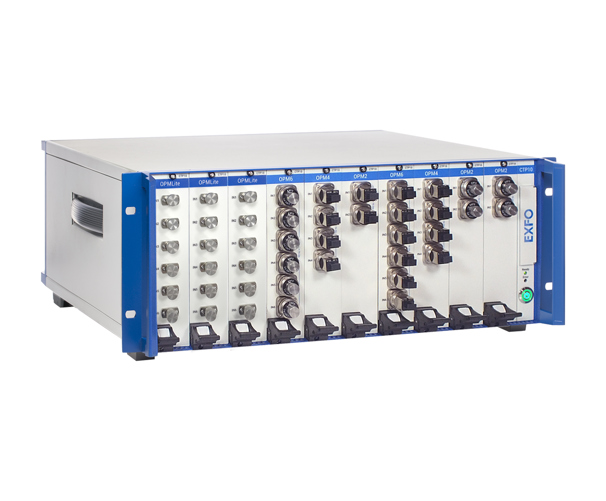
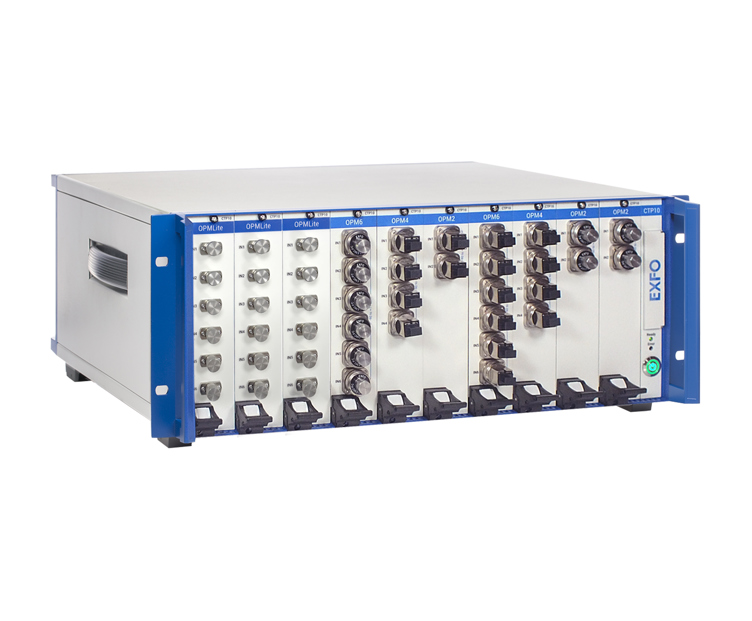
| Number of module slots - Front panel of mainframe | 10 |
| Other inputs - Front panel of mainframe | 3x USB-A 2.0 |
| Data storage - Hard drive | HDD, 2 TB |
| Temperature - Storage | –20 °C to 65 °C (–4 °F to 149 °F) |
| Temperature - Operating | 5 °C to 40 °C (41 °F to 104 °F) |
| Weight - Mainframe | 8.5 kg (18.7 lb) |
| Weight - Module | 1 kg to 2.8 kg (2.2 lb to 6.2 lb) |
| Dimensions (mainframe – H × W × D) | 178 mm × 482 mm × 435 mm (7 in × 19 in × 17 in) / 4U full rack with rackmount fixtures |
| Power supply | 100 V to 240 V AC (50/60 Hz) |