


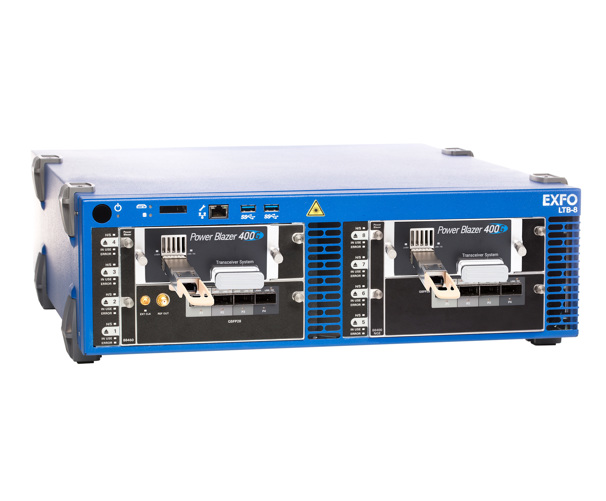
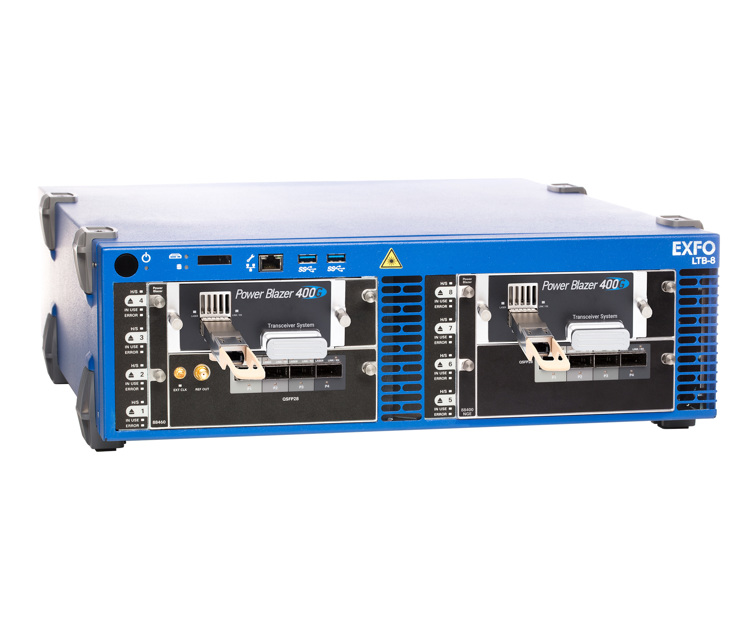
| Detailed compliance testing | IEEE 802.3ba and IEEE 802.3bs standard |
| Multi-interface support | Pluggable MSA-compliant 4 x 25G QSFP28 transceivers; AOC QSFP28/QSFP-DD cable support; CFP MSA management interface specification version 2.6 (R06a); QSFP-DD MSA revision 4.0, 8 x 50G and 4 x 100G; OSFP MSA revision 2.0, 8 x 50G and 4 x 100G; 400G DAC cables support; Pluggable, MSA-compliant QSFP+ transceivers; Pluggable, MSA-compliant SFP28 optical transceiver; Pluggable, MSA-compliant SFP/SFP+ optical transceivers |
| Line rate | 425/212.5/106.25 (single lambda)/103.125/53.125/41.25 Gbit/s, 100G SRBD, 25GE, 10GE LAN, 10GE WAN and 1GE OIF DCO Coherent OSFP & QSFP DD ZR and ZR+ |
| 400G ecosystem support | 400/200GbE, FlexE and OTUCn and FlexO |
| Robust physical-layer validation | 400GAUI lane-error generation and monitoring; PCS lane mapping and monitoring capability; per-lane skew generation and measurement; PCS error generation and monitoring per lane; full MDIO/I2C read/write access |
| Transceiver and cable validation | SFP, SFP+, SFP28, QSFP+, QSFP28, QSFP56, QSFP-DD, OSFP and CFP2-DCO |
| iOptics | Optical-device I/O interface quick check; optical Tx power-level test; optical Rx signal-presence and level test; stress test; excessive skew test; temperature and power consumption monitoring; host and media loopback |
| Power measurement | Optical channel power measurement with color indicators per lane |
| Frequency measurements | Allow users to measure the received frequency per wavelength (in Hz) in the used of parallel optics |
| Frequency offset | Offsetting of the transmitted signal's clock on a selected interface, and monitoring |
| Transceiver non-blocking analysis | Enables a step-by-step monitoring of the transceiver boot-up sequence |
| BERT | BERT framed and unframed testing using different parameters, different frame sizes, including EMIX |
| Service disruption time (SDT) | Service disruption time measurements based on no traffic, mode, with statistics including longest disruption time, shortest, last, average, count, total and pass/fail thresholds |
| Latency measurements in BERT | High-resolution delay measurements integrated in the BER with statistics including current, average, maximum, minimum, count, total and pass/fail thresholds |
| Error injection mode | Manual, rate and continuous (maximum rate) |
| Layer 2 | MAC address and Ether type edition available; Q-in-Q capability with the ability to go up to three layers of stacked VLANs |
| Layer 3/4 | Source and destination IP address configuration available; IP TOS/DSP configuration available; UDP source and destination port configuration available |
| RFC 2544 | Throughput, back-to-back, frame loss and high-resolution latency measurements according to RFC 2544; frame size: RFC-defined or user-configurable |
| EtherSAM | Simplified ITU-T Y.1564 test that performs service configuration and service performance tests using remote loopback or dual test set mode for bidirectional results |
| Traffic generation and monitoring | Traffic generation and shaping of up to 16 streams of Ethernet and IP traffic, including the simultaneous monitoring of throughput, frame loss, packet jitter, latency and out-of-sequence frames, including MAC flooding for source and destination MAC addresses |
| Breakout cable support | Verification of 2 x 100GE, 4 x 100GE, 2 x 200GE and 8 x 50GE breakout cables providing optical Tx/Rx power, L2/L3 traffic and BERT statistics per link |
| Smart loopback | Return Ethernet traffic to the local unit by swapping packet overhead up to layer 4 |
| Rx frame-size analysis | < 64, 65 - 127, 128 - 255, 256 - 511, 512 - 1023, 1024-1518 and > 1518 |
| Rx rate | Line utlization (%), Ethernet BW (Mbit/s), frame rate (frame/s), and frame count |
| Ethernet alarms | Link down, local fault detected, local fault received, remote fault, LOA |
| Ethernet errors | FCS, jabber, runt, undersize and oversize |
| Higher layer error analysis | UDP checksum |
| PCS lane alarms and errors | LOS, LOC-lane, LOAML, excessive skew, Inv. Marker, Pre-FEC SYMB and Pre-FEC-bit |
| Skew insertion | Per-lane skew generation and measurement range 0 to 10550 |
| PCS logical lane mapping | Manual and random |
| FEC | Generation and analysis of FEC correctable and uncorrectable errors, local and remote degraded SER monitoring |
| FEC statistics | Number of symbol errors per correctable codeword, number of pre-FEC symbol errors and bit statistics, codeword count (error-free and uncorrectable) and percentage |
| PAM4 histogram | Provides a graphic view from PAM4 eye diagram per lane, including PAM4 levels |
| Pre-emphasis | Pre-/main-/post- cursor, lower/upper eye and swing (%) options to improve electrical waveform |
| IP tools | Performs ping and traceroute functions |
| IPv4 and IPv6 testing | Performs the following tests up to 400G over IPV4 and IPv6, RFC 2544, BERT, traffic generation and monitoring, EtherSAM, ping and traceroute |
| Advanced filtering | Configure up to 10 filters, each with four fields that can be combined with AND/OR/NOT operations; a mask is also provided for each field value with IPv4 or IPv6 capabilities |
| Remote access | Supported via EXFO Remote ToolBox, Remote Desktop, VNC and EXFO Multilink for multiuser support |
| Automation | Wide range of commands available per application to allow test automation |
| Reporting | Test results are included in a report that can be generated in different formats: pdf, html and json |
| UNFRAMED BER TEST – Pattern configuration | 16 unframed 400GAUI-16 lanes, 16 unframed 400GAUI-8 lanes, 8 unframed 400GAUI-8 lanes, 4 unframed 200GAUI-4 lanes and 8 unframed 200GAUI-4 lanes |
| UNFRAMED BER TEST – PRBS patterns per lane | Allow users to configure different PRBS patterns on different 400GAUI lanes |
| UNFRAMED BER TEST – Patterns | PRBS 2E31-1, PRBS 2E23-1, PRBS31Q, PRBS13Q, SSPRQ capability to invert patterns |
| UNFRAMED BER TEST – Error measurement | Mismatch 0, mismatch 1, bit error and pattern loss per 400GAUI/200GAUI lane displayed in seconds, count and rate |
| UNFRAMED BER TEST – Alarm injection | Capabilities to inject pattern loss and LOS per 400GAUI/200GAUI lane continuously |
| Flex ETHERNET – Compliance | Compliant with OIF, FlexE 2.0 |
| Flex ETHERNET – Multi-interface support | Four QSFP28 ports, one port QSFP-DD or OSFP port to configure FlexE traffic up to 400GE |
| Flex ETHERNET – RS-FEC support | RS-FEC capabilities per port |
| Flex ETHERNET – Skew monitoring | Graphical skew monitoring per port |
| Flex ETHERNET – Skew insertion | Per-port skew generation and measurement range 0 to 10000 ns |
| Flex ETHERNET – PHY number | FlexE PHY number per port edition available |
| Flex ETHERNET – Group number | FlexE group number edition available |
| Flex ETHERNET – Client | Client ID and Mac address edition available per client |
| Flex ETHERNET – Calendar type | Calendar A/B configuration and monitoring |
| Flex ETHERNET – Calendar edition | Graphical calendar configuration per slot/client/clients for FlexE bonding, sub-rate and channelization |
| Flex ETHERNET – Clients available | Different client configuration included 5GE, 10GE, 25GE, 40GE, 50GE, 100GE, 150GE, 200GE, 250GE, 300GE, 350GE and 400GE |
| Flex ETHERNET – Ports capacity | Display the calendar used, unused and assigned capacity in Gbit/s |
| Flex ETHERNET – Client statistics | Size, Tx and Rx rate in Gbit/s, frame count |
| Flex ETHERNET – BERT | Selectable FlexE client bit error rate analysis using a specific pattern |
| Flex ETHERNET – BER error injection | Manual, rate and continuous (maximum rate) |
| Flex ETHERNET – Error/alarms monitoring and injection | Per port FlexE PHY, per FlexE group and per client |
| Flex ETHERNET – FlexE overhead | Display a detail overview from block 1 to 8 per frame from the FlexE overhead for Tx and Rx |
| Flex ETHERNET – FlexE G.mtn path OAM | (pre-standard version) Support of CC function status, connectivity verification, bidirectional delay measurement and CS type monitoring |
| TRANSPORT TESTING – OTN interfaces standards compliance | ITU-T G.709, G.798, G.872 and ITU-T G series Supplement 43 |
| TRANSPORT TESTING – OTN interfaces line rates | OTU3 (43 Gbit/s), OTU3e1 (44.57 Gbit/s), OTU3e2 (44.58 Gbit/s), OTU4 (111.81 Gbit/s) |
| TRANSPORT TESTING – OTN interfaces power measurement | Optical channel power measurement with color indicators |
| TRANSPORT TESTING – OTN interfaces frequency measurement | Clock frequency measurements displayed in Hz |
| TRANSPORT TESTING – OTN interfaces frequency offset | Offsetting of the transmitted signal’s clock on a selected interface, and monitoring to exercise clock recovery circuitry on network elements |
| OTL layer – Errors per lane | Invalid marker, FAS |
| OTL layer – Alarms per lane | OOF, LOF, LOR, OOR, excessive skew |
| OTL layer – Global alarm | LOL |
| OTU layer – Errors | OTU-FAS, OTU-MFAS, OTU-BEI, OTU-BIP-8 |
| OTU layer – Alarms | LOF, OOF, LOM, OOM, OTU-TIM, OTU-BDI, OTU-IAE, OTU-BIAE, OTU-AIS |
| OTU layer – Traces alarms | 64-byte trail trace identifier (TTI) as defined in ITU-T G.709 |
| ODU layer – Errors | ODU-BIP-8, ODU-BEI |
| ODU layer – Alarms | ODU-AIS, ODU-OCI, ODU-LCK, ODU-TIM, ODU-BDI, ODU-FSF, ODU-BSF, ODU-FSD, ODU-BSD, ODU-LOFLOM |
| ODU layer – Traces | 64-byte trail trace identifier (TTI) as defined in ITU-T G.709 |
| FTFL | Fault type and fault location byte; as defined in ITU-T G.709 standard |
| ODU TCM layer – Errors | TCMi-BIP-8, TCMi-BEI (i = 1 to 6) |
| ODU TCM layer – Alarms | TCMi-LTC, TCMi-TIM, TCMi-BDI, TCMi-IAE, TCMi-BIAE |
| ODU TCM layer – Traces | 64-byte trail trace identifier (TTI) as defined in ITU-T G.709 |
| OPU layer – Alarms | OPU-PLM, OPU-CSF, OPU-AIS, OPU-MSIM, OPU LOOMFI, OOMFI, OMFI a |
| OPU layer – Payload type | Generates and displays received PT value |
| Forward error correction (FEC) – Errors | Generation and analysis of FEC correctable and uncorrectable errors |
| Ethernet mapping over OTN | 40G and 100G Ethernet mapping over OTU3 and OTU4, respectively, using GMP |
| 40GE transcoding capability | 40G transcoding capability with alarms, errors and statistics |
| GMP – Alarms, errors and statistics | GMP alarms, errors and statistics |
| GigE mapping | GigE mapping into ODU0 using GFP-T, 10 GigE mapping into ODU2 using GFP-F, direct 10 GigE mappings into ODU1e and ODU2e in different ODU multiplexing structures |
| 40GE into OTU3 into OTU4 | Flexibility to map up to a 10G Ethernet client signal into ODUflex |
| 40GE transcoding – Errors | Invalid flag, POS violation, MSEQ violation, PCS-BIP-8 mask per lane, PCS-BIP-8 per lane, OTN-BIP-8 per lane, SEQ violation |
| 40GE transcoding – Alarms | LOBL 1027B, Hi-BER 1027B, LOAML 1027B |
| GMP – Errors | Cm CRC-8, CnD CRC-5 |
| GMP – Alarms | GMP OOS a |
| GMP – Statistics | Cm minimum/maximum values and CnD minimum/maximum values for both GMP Tx and Rx |
| ODU3/ODU4 multiplexing – Mappings | ODU13, ODU23, ODU123, ODU03, ODU013, ODU0123, ODU04, ODU014, ODU134, ODU24, ODU234, ODU34, ODU14, ODU01234, ODU0124, ODU024, ODU034, ODU1e4, ODUflex24, ODU2e4 and ODU124, ODU1234 with PRBS pattern and GigE, 10 GigE, 40 GigE and 100 GigE client mappings into OPU payloads |
| ODU3/ODU4 multiplexing – Alarms | ODU34, ODU14, ODU01234, ODU0124, ODU024, ODU034, ODU1e4, ODUflex24, ODU2e4 and ODU124, ODU1234 with PRBS pattern and GigE and 10 GigE client mappings into OPU payloads |
| ODU3/ODU4 multiplexing – Clients | GigE, 10 GigE, 40 GigE and 100 GigE client mappings into OPU payloads |
| ODU0 | ODU0 (1.25 Gbit/s) container with Gigabit Ethernet and PRBS pattern |
| ODUflex | ODUflex at ODU3 and ODU4 rates with full flexibility to configure the required bandwidth based on n x 1.25 Gbit/s tributary time slots with a PRBS pattern into the ODUflex payload |
| GFP-F/T – Errors | GFP-cHEC-CORR, GFP-cHEC-UNCORR, GFP-tHEC-CORR, GFP-tHEC-UNCORR, GFP-eHEC-CORR, GFP-eHEC-UNCORR, GFP-pFCS |
| GFP-F/T – Alarms | GFP-LFD, GFP-EXM, GFP-UPM, GFP-DCI, GFP-FDI, GFP-RDI, GFP-LOCS, GFP-LOCCS, GFP-reserved CMF |
| GFP-F/T – Frame type statistics | Client data, client management, idle, reserved PTI, reserved PLI, invalid, discarded |
| GFP-F/T – Rx mismatch | PFI, EXI, UPI, CID |
| GFP-F/T – GFP-T superblock statistics | Valid, invalid and total |
| COHERENT OPTICS – Compliance | OIF 400ZR, IEEE 802.3cw, OpenZR+, OpenROADM |
| COHERENT OPTICS – Tx power | Optical power Tx transceiver configuration |
| COHERENT OPTICS – Wavelength | Transceiver grid configuration |
| COHERENT OPTICS – Optical metrics | Test set displays the following optical metrics CD (ps/nm), CFO (MHz), DGD (ps), OSNR (dB), PDL (dB), SOPCR (Krad/s), SOPMD (ps2) |
| COHERENT OPTICS – Client configuration | Ethernet client L2/3 and L4 configuration |
| COHERENT OPTICS – Ethernet frame | Client Ethernet frame configuration fixed or EMIX |
| COHERENT OPTICS – Ethernet client BERT | Bit error analysis using PRBS31 supporting alarm/error monitoring and injection |
| COHERENT OPTICS – FED | User can enable FEC excessive degrade alarm monitoring |
| COHERENT OPTICS – FDD | User can enable FEC detected degrade alarm monitoring |
| COHERENT OPTICS – FEC alarms | FED and FDD alarms monitoring |
| COHERENT OPTICS – FEC error monitoring | FEC-UNCOR-FR and FEC-COR-BITS monitoring |
| COHERENT OPTICS – Ethernet alarms | Link down, L Fault Det, L Fault Rcd, Remote fault LOA alarms |
| COHERENT OPTICS – Ethernet errors | 66B Block, FEC-UNCOR-FR, FEC-COR-BITS, FCS, Jabber, runt and undersize errors |
| COHERENT OPTICS – Error and alarm injection | User can inject Interface, Ethernet, PCS and BERT errors and alarms |
| COHERENT OPTICS – DCO Tx alarms | Tx LOA, Tx OOA, Tx CMU LOL, Tx RefClk LOL, Tx Deskew LOL, Tx FIFO |
| COHERENT OPTICS – DCO Rx alarms | Rx LOF, Rx LOM, Rx Demod LOL, Rx CDC LOL, Rx LOA, Rx OOA, Rx Deskew LOL, Rx FIFO |
| OTUCn/FlexO – Compliance | ITU-T G.709, ITU-T G.709.1 and ITU-T G.798 |
| OTUCn/FlexO – Multi-interface support | FOIC (QSFP28) ports available testing up to 419G |
| OTUCn/FlexO – RS-FEC support | RS FEC error monitoring and injection per PHY |
| OTUCn/FlexO – FlexO Instance ID | ID number selection, monitoring and and mismatch detection |
| OTUCn/FlexO – FlexO Group ID | Group ID number selection, monitoring and mismatch detection |
| OTUCn/FlexO – FOIC | Supports FOIC per lane alignment marker monitoring and error injection |
| OTUCn/FlexO – Skew | Skew alarm monitoring on PHYs and skew values reported per FlexO instance |
| OTUCn/FlexO – BERT | Bit error analisys using PRBS31 supporting alarm/error monitoring and injection |
| OTUCn/FlexO – BER error injection | Manual, rate and continuous (maximum rate) |
| OTUCn/FlexO – OTUCn Frame | OTUC1, OTUC2, OTUC3 and OTUC4 level alarms/error monitoring and injection |
| OTUCn/FlexO – ODUCn/ODUk | ODUC1, ODUC2, ODUC3 and ODUC4 level alarms/error monitoring and injection |
| OTUCn/FlexO – OTUCn Trace | Trace configuration and monitoring |
| OTUCn/FlexO – ODUCn/ODUk trace/payload type | Trace/payload type configuration and monitoring |
| a. Alarm analysis only. | |
| Size (H x W x D) | 101 mm x 159 mm x 175 mm (4 in x 6 1/4 in x 6 7/8 in) |
| Weight | 1.70 kg 3.75 lb a |
| Temperature – Operating | 0 °C to 40 °C (32 °F to 104 °F) |
| Temperature – Storage | —40 °C to 70 °C (—40 °F to 158 °F) |
| REF-OUT INTERFACE – Tx pulse amplitude | 200 mVpp to 1300 mVpp, depending on frequency |
| REF-OUT INTERFACE – Transmission frequency | 155 MHz to 3.50 GHz |
| REF-OUT INTERFACE – Output configuration | AC-coupled |
| REF-OUT INTERFACE – Load impedance | 50 Ω |
| REF-OUT INTERFACE – Connector type | SMA |
| REF-OUT INTERFACE – External cable | Maximum 1 meter cable length (RG178 cable with 3.1 dB/m attenuation at 3.5 GHz) |
| Laser safety | Module: The host unit that you use with your module may have different laser classes. Refer to the host unit documentation for exact information. |
| a. With filler. | |