


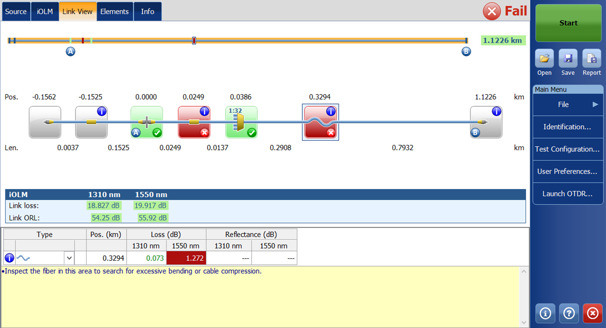
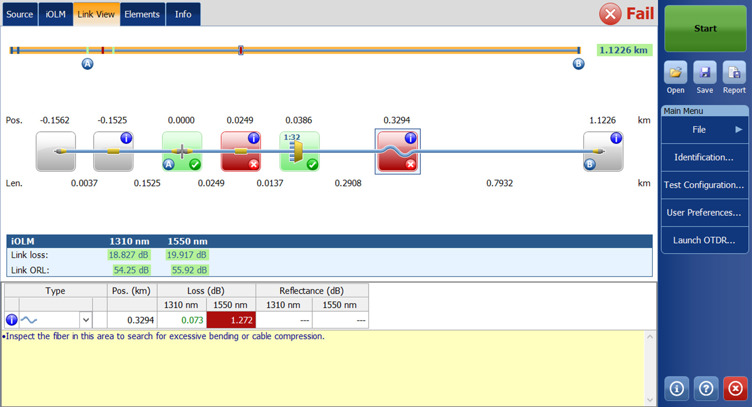
| Application | OTDR-based intelligent Optical Link Mapper (iOLM) software for automated fiber-link characterization on EXFO handheld and modular OTDR platforms. |
| Key features | Self-adjusting unit that adapts test parameters to any fiber link, performs intelligent multiacquisitions at multiple wavelengths with icon-based link view, provides comprehensive fault diagnostics, consolidated bidirectional link view and generates OTDR trace files (.sor). |
| Pass/fail thresholds | TIA/IEC automated pass/fail thresholds available as an option for enterprise and data center applications. |
| Loopback testing | Optional iLOOP mode can test two fibers simultaneously using loopback single-ended measurements, then splits results into individual links with separate iOLM and OTDR (.sor) files and a PDF report. |
| Supported network applications | Point-to-point (P2P) access; FTTx last mile; LAN/WAN, enterprise and data center certification; FTTx/PON MDU; fronthaul (FTTA, DAS and small cells) and backhaul; FTTH unbalanced/tapered PON; passive optical LAN (POL); metro core and longhaul; CWDM/DWDM; cable certification (IL/ORL measurement). |
| Supported topologies | Supports P2P, centralized PON, cascaded PON and unbalanced/tapered PON within the standard iOLM application. |
| Compatible platforms | FTB family platforms, available on MaxTester 700B/C/D OTDR Series, FTBx-700C/D OTDR Series and FTB-7000E OTDR Series. |
| Optimodes | Short-link close events mode for short links with closely spaced connectors (e.g., FTTA, data centers, central offices, FTTx); Fast short link (FSL) mode for high-volume testing of short connectorized links in less than 10 seconds per fiber; Fast medium range (FMR) mode for P2P spliced links such as FTTH feeder and distribution, DCI and backhaul, characterizing a link under 20 km at 2 wavelengths. |
| Additional Optimodes | SFP safe troubleshooting mode for P2P links up to 100 km and passive CWDM/DWDM while protecting SFPs from uncontrolled pulse widths; PON last-mile certification mode to test all connections from customer premises to the splitter, including splitter continuity but excluding elements after the splitter. |
| Bidirectional analysis | Bidirectional analysis combines results from both directions to provide average loss per event, using multiple pulse widths and wavelengths to ensure accurate splice characterization and a consolidated bidirectional link view. |
| Advanced SOR support | Manages an unrestricted number of acquisitions and lets the user define pulse width, averaging time and wavelength(s) for the SOR trace included in the report, with the ability to view the reported SOR trace directly in iOLM. |
| Expert mode | Expert mode allows creation of custom network elements with user-defined icons and thresholds, as well as advanced trace editing and re-analysis, for example treating a spliced pigtail connector as a combined splice and connector event. |
| Data center certification (iCERT option) | iCERT option transforms iOLM into an intelligent Tier-2 certifier with automated pass/fail thresholds for SM/MM cables and supports simultaneous certification against multiple cabling and application standards, including TIA-568, ISO 11801, IEEE and Fibre Channel standards. |
| Type d'application | Logiciel de visualisation intelligente de lien optique (iOLM) basé sur OTDR, dédié à la caractérisation automatisée de liaisons fibre. |
| Plateformes compatibles | Séries OTDR portatives MaxTester 700B/C/D, plateformes FTBx-700C/D et gamme OTDR FTB-7000e. |
| Principales caractéristiques standard | Configuration automatique qui s'adapte de façon dynamique à n'importe quelle liaison par fibre, multiacquisitions intelligentes à différentes longueurs d'onde combinées en une seule visualisation des liaisons basée sur des icônes, diagnostic et directives exhaustives des anomalies, visualisation des liaisons bidirectionnelle consolidée (en attente de brevet) et création de fichiers de trace OTDR (.sor). |
| Seuils de certification | Seuils succès-échec TIA/CEI automatiques pour les entreprises et centres de traitement de données (en option). |
| Applications réseau principales | Accès point à point (P2P), dernier km des réseaux FTTx, certification de réseaux LAN/WAN, d'entreprises et de centres de traitement de données, FTTx/PON MDU, fronthaul (FTTA, DAS et petites cellules) et réseau de collecte, réseau PON de FTTH avec coupleurs asymétriques/coniques, réseau local optique passif (POL), cœur du réseau métropolitain et longue distance, CWDM/DWDM et certification de câbles (mesure IL/ORL). |
| Topologies prises en charge | P2P, réseau PON centralisé, réseau PON en cascade ou réseau PON avec coupleurs asymétriques/coniques (couvert par l'iOLM standard). |
| Technologie Link-Aware | Reconnaissance automatique de la liaison, définition des paramètres optimaux, lancement de multiples acquisitions, analyse de l'élément de liaison et exportation vers un seul rapport. |
| Autoconfiguration | Configuration automatique de tous les paramètres de tests, réduction du temps de formation et prévention des erreurs de paramétrage de tests. |
| Visualisation de la liaison optique | Portrait clair de la fibre testée avec des icônes et des verdicts succès-échec faciles à comprendre. |
| Diagnostic intelligent | Guidage à chaque étape du processus de résolution de problème réseau. |
| Traces OTDR et fichiers iOLM | Trace OTDR en format universel Bellcore (.sor) comprenant les données supplémentaires recueillies par l'iOLM et génération d'un fichier iOLM unique pour chaque liaison basé sur plusieurs acquisitions. |
| Analyse bidirectionnelle | Combinaison des résultats des deux directions pour fournir une perte moyenne pour chaque événement, avec plusieurs largeurs d'impulsion à plusieurs longueurs d'onde et vue consolidée. |
| Optimode : événements rapprochés du lien court | Adapté aux liens courts avec des connecteurs rapprochés (FTTA, centres de données, FTTx, bureaux centraux), offrant la meilleure résolution à ce jour pour séparer des connecteurs rapprochés lors du dépannage avec des panneaux de brassage rapprochés. |
| Optimode : Fast short link (FSL) | Conçu pour tester rapidement des liens de câbles à connecteur courts dans les situations de volumes importants (centres de données, réseaux LAN/WAN d'entreprise, FTTA); tests jusqu'à cinq fois plus rapidement que la caractérisation par iOLM régulière avec perte de liaison précise, longueur et cartographie de haut niveau de la liaison en moins de 10 secondes par fibre. |
| Optimode : Fast medium range (FMR) | Test rapide des liaisons P2P épissées dans les situations de volume important (caractérisation des câbles d'alimentation et de distribution FTTH, DCI, réseau de collecte); caractérisation d'une liaison de moins de 20 km à 2 longueurs d'onde en 30 secondes. |
| Fonctions iOLM Advanced (iADV) | Résultats des tests en temps réel avec laser de l'OTDR en mode d'émission continue, soutien SOR avancé avec gestion d'un nombre illimité d'acquisitions, vue de la trace SOR, caractérisation de coupleurs 2:N, mode expert avec éléments de réseau personnalisés et édition de trace avancée, Optimode de dépannage SFP sécuritaire et Optimode de certification du dernier kilomètre du réseau PON. |
| Fonctions iLOOP(a) | Mode de test à boucle de retour permettant de tester deux fibres simultanément avec mesure unilatérale; réduction de moitié du temps de test; partage des résultats en deux liaisons individuelles pour générer des fichiers iOLM et OTDR (.sor) distincts et rapport PDF sans attendre le post-traitement; résultats bidirectionnels automatisés bilatéraux et caractérisation bidirectionnelle automatisée et flexible. |
| Fonctions iCERT(b) | Certificateur intelligent de niveau 2 avec des seuils succès-échec automatisés pour les câbles monomode et multimode; certification du câblage conformément aux normes internationales reconnues (TIA-568, ISO 11801) et des applications que la fibre peut transporter (normes IEEE et Fibre Channel). |
| Bobines amorces et câbles de réception | Bobines amorces d'une longueur jusqu'à 15 m conviennent à la plupart des applications grâce à l'approche dynamique à largeur multi-impulsion; l'iOLM peut recommander des gammes de longueurs et étalonner la longueur de la bobine amorce et de la fibre de réception pour des résultats optimaux. |
| (a) Offert pour les appareils FTB à double port équipés des modules FTBx-730C/735C/750C, d'iOLM et de la fonction iLOOP. Nécessite un kit d'accessoires par appareil FTB (PCK-BIDIR120 KIT) pour les résultats bidirectionnels automatisés bilatéraux. EXFO Exchange est requis pour l'analyse bidirectionnelle unilatérale automatisée. (b) Nécessite le logiciel iOLM de base. Plusieurs options iOLM avancées (iADV, iLOOP et iCERT) sont disponibles comme mises à niveau logicielles. (c) Pour les fibres multimodes, EXFO recommande l'utilisation d'un conditionneur de mode de lancement externe conforme au flux encerclé (EF) selon les normes TIA-568, TIA-526-14-B et IEC 61280-4-1 éd. 2.0. Pour en savoir plus sur la compatibilité au flux encerclé, veuillez consulter la fiche technique de la solution de tests à flux encerclé. | |